Arrival & Humanity

conscious-movie-reviews-arrival-circle_2

In Denis Villeneuve’s Arrival, a mid-budget science fiction picture based on the short fiction “Story of Your Life” by Ted Chiang, a linguist(Amy Adams) and a theoretical physicist(Jeremy Renner) are employed by the United States government to communicate with a new group of other worldly visitors.

The film explores the nature of language and the limitedness of our own understanding.  It’s an ambitious picture that evokes ideas and high-stakes drama rather than the typical shiny big-budget action, even though by the nature of the product it has to do so in a superficially engaging, clearly-evidenced way.  One of the more intense action sequences involves Amy Adams running through a military base with a satellite phone — the tension rises from the misunderstandings of her coworkers rather than the enormous, tentacled visitors.

But isn’t the conversation limited by its very definition?  When the linguist dissects the question “what is your purpose on earth?” she limits it to an elementary, very human understanding while expanding on the nature of each component: they must realize what purpose is, they must understand the singular you vs the group you, etc.

arrival-movie-review.jpgIt’s a limited question to begin with, because communication takes place by a thousand different methods.  Even humans, when communicating verbally, supplement that with unintentional nuances: phrasing, voice, body language, etc.  By attributing meaning to visual aids for communication, they’re taking extreme steps toward anthropomorphizing entities which they don’t have the slightest idea about.  The heptapods(what they refer to the aliens as) are assigned, almost by default, after verbal fails to make an effect, a visual style of communication.  Their mere response(initially, verbally) totally ignores the fact that the visitors don’t have intelligible eyes or mouths or ears.

The only way this style of communication makes any sense at all is if we recognize that either there has been an extreme coincidence and humans and aliens communicate by interchangable, adaptable mediums, or that the heptapods are condescending to the human version of communication.  What about smells?  Simple, physical gestures?  Telepathy?  Why not some combination, or expression by another sense that the human race doesn’t possess?  And, even then, who’s to say that their vocabulary and their understanding of physical space is relative to the same human version?  These are entities who aren’t restricted by science as humanity understands it, or by time.

The overlap must then be a creation by the alien creatures who know of the future and know that they are going to depend on humanity 3000 years in the future.  Why must the first contact be so muddled and confusing, when the heptapods have a thorough and complete understanding of their entire future?  Has this been assessed as the most desirable timeline?  When the aliens quickly react to the bomb as it explodes in their ship, an instant before it detonates, it shows that, if they don’t have a complete, psychic understanding of every moment that is to come, that at least they can recognize the numbers and signals of the contraption: they knew what was going to happen, and they reacted accordingly, in a limited fashion.

That must then be the only way that they are able to respond: there must then be tight pockets of the future with acceptable places for intervention and necessary, even negative events to be compounded by those same actions.  This becomes especially clear when one of the aliens reveals to Adams’ character that his companion has died.

What might be the most intriguing concept throughout the entire film, that especially recognizes the inane nature of their compatibility in communication, might be when the heptapods reveal that they will require help from humanity in 3,000 years.

arrival-movie-review-3.jpgWhat does that say about humanity, and especially what does that imply about transitional value?  A clearly more advanced species whose reality transcends time and space still requires something from the human race.  The best of science fiction is that which attempts to understand humanity through alternative metrics: the clearest, most pragmatic, quantifiable view of the future understands that intelligence and  understanding transcend the mere state of being.  But there are other, less quanitifiable, sometimes even less qualifiable details that still contribute to informing what the human race represents.  It’s hopeful to attempt to view those outside of our own constructed system, against the backdrop of the universe.  Humans aren’t cash-cows or war-mongerers by their very nature.  We can be so much more than what can simply be determined by those vague, vapid realizations.

Fences & the Baseball Metaphor

fences-movie-1050x525

“That’s strike one. See, you in the batter’s box now. You swung and you missed. That’s strike one. Don’t you strike out!”

August_Wilson.jpgThe baseball metaphor, the whole concept of ‘three strikes and you’re out’, is tried and true as a cultural idiom.  In Denzel Washington’s latest directorial effort, his first in nine years and an adaptation of a Pulitzer Prize winning August Wilson play(Washington also plans to executive-produce the rest of the author’s ten play Pittsburgh Cycle), Fences, that metaphor is employed as a shallow, subjective assessment of a simple life.

Troy Maxon(Washington) is a garbage collector who bases his entire life around the idea that he almost made it in baseball.  He’s arrogant and boorish, drinking straight from the bottle, filling every conversation with an influx of his own words.  The title of the play comes from his promise to build his wife, Rose(Viola Davis), a fence around their property — something that he puts off further and further into the future.  He plans and he talks, but he never does anything.  He tosses his anger and frustration and bitter disappointment all around him, throwing around his cold assessment of reality especially where it relates to his youngest son, Cory: “what law is there say I got to like you?”

It’s difficult to fully comprehend a film with a black cast and a historical setting without acknowledging the racial component of the story.  It’s the cold, rejecting world of the 1950s, where the mere fact that Troy is able to have himself promoted to a driver of a garbage truck rather than a lifter of garbage cans is viewed as at least a small racial victory.

Fences227_Denzel_Washington_as_Troy_Maxson_Bat.jpgThe world kicks and beats Troy down, so he finds a place to kick and beat down his own.  Rose is his wife, and as such she is his simple support, always lingering in the background.  Where his son Cory tries to make it playing football, his father shoves his own ideals down his throat: “The white man ain’t gonna let him get nowhere with that football. I told him when he first come to me with it. Now you come telling me he done went and got more tied up in it. He ought to go and get recruited in how to fix cars or something where he can make a living.”

The brief, tenuous control that Troy has is what he feels he most desperately needs to hold onto.  By subjecting his wife to his whims and by exerting an influence of power over his son, he creates a universe subjective to his framing understanding of baseball.  Where Cory disobeys him and undermines his authority, he assigns strikes.
When Rose goes out of line, simply by asserting that Troy isn’t the perfect, giving figure he views himself as after he comes and confesses to her that he’s impregnated another woman, he grabs her.  Cory rushes in, protective of his mother, pushing his father away.  Strike two.

HT_viola_davis_fences_jef_160927_12x5_1600.jpgIn their final scene together, Cory comes through the yard and tries to enter his home.  His drunk father sits on the steps, mulling over his life, and again decides that it’s his right to take it out on his son.  This is his flesh and blood, who he has worked to make money for and support, so he feels it’s his God-given right to subject the boy to a vicious torrent of verbal abuse — he feels it’s his duty to fashion a precise, contrived version of what he feels man is supposed to represent.

What’s glaring here is how the baseball metaphor becomes less overt: while this is obviously Cory’s third strike, and while it culminates with the boy leaving, totally separated from his father and with nothing but hate and contempt in his heart,  the ever-talkative, verbose Troy never absolutely acknowledges the state of that strikeout.

In fact, as soon as Cory leaves, Troy picks up the bat and stands there, holding it over his shoulder, bracing against the metaphor of death expressed in a fastball.

BN-RF867_FENCES_P_20161215105142.jpgWhat especially runs in the more general extension of this metaphor is a conversation between Cory and Troy’s older son, Lyons in the final scene, meeting before their father’s funeral.  Lyons says: “You got to take the crookeds with the straights. That’s what Papa used to say. He used to say that when he struck out. I seen him strike out three times in a row…and the next time up he hit the ball over the grandstand.”

This illuminates on the limited nature of the baseball metaphor: even the one who assigned it recognizes that there’s a whole enormous game that lives outside of that simple, defining reach.  There’s a whole batting order that follows, and you’ll always have another chance to swing.  When Cory struck out, Troy stepped back up to the plate.  It wasn’t the end or the beginning of anything, it was merely a few more steps into a cycle that would continue repeating itself in perpetuity.  There would always be another chance up at bat.


The Best Song of 2016

48510480-cached

When Kanye West burst to the forefront of the hip-hop scene, he did it with a cool, calm, self-described ‘dope-ass’ beat transfixed against honest lyrics that reflected a deep, personal belief in something greater than himself.  ‘Jesus Walks’ questions the identity of the modern black man, weighing out a thug reality against the traditional, whitewashed realization of Christianity.

“God show me the way because the Devil’s trying to break me down,” he rapped.

kanye-west-fashion-gallery-college-dropout.jpg
The song was the start of a consistent trend in West’s music: on dozens of tracks since, Kanye’s referenced his faith, and especially whre it has played into informing his constantly changing, subjective reality.  When the Old Kanye, the cool, polo and a backpack Kanye, became an entity unto itself(post Graduation & the dropout bear), the New Kanye began to dig deeper and deeper into the clinical and social issues that weighed on him.

He went back into religion, time and again.  But he struggled with it, viewing himself as the be all and the end all of the industry and music as a collective whole.  808s & Heartbreak, the most obvious sign of a departure from the pop genius of his past, came with a celebration of everything he saw in himself and what he tried to convince himself of his own accomplishments: this is evidenced in the relationship of lines like “(i)t’s amazing, my reign is so far as your eyes can see” juxtaposed against “I’m a problem that’ll never be solved”.  His honesty shines through the freestyle track ‘Pinocchio Story’, singing: “There is no Gucci I can buy / There is no Louis Vuitton to put on /There is no Y.S.L. that they could sell /To get my heart, out of this hell / And my mind, out of this jail”.
His lyrical shift from consumerism and narcissism to personal struggles highlighted a fundamental change from the rapper that had once touted “Did you realize /That you were a champion in their eyes? / Yes I did / So I packed it up and brought it back to the crib”.

Kanye’s journey toward realization of himself had been packed full of contradiction: for every “Tell me how do you respond to students? / And refresh the page and restart the memory? /Respark the soul and rebuild the energy /We stopped the ignorance, we killed the enemies /Sorry for the night demons still visit me /The plan was to drink until the pain over / But what’s worse, the pain or the hangover?” there’s a “Praises due to the most fly, prada / Baby I’m magic ta da / Address me as your highness, high as United”

Yeezus took this trend and absolutely blew subtlety out of the water.  A mere look at track titles like ‘I Am a God’, which boasts such phrases as “I just talked to Jesus / He said, whattup, Yeezus? / I said ‘Shit, I’m chillin’’ / Just tryin’ a stack these millions'” show a man who feels he has so much to prove that he overcompensates; after all, this is the same Kanye who once touted “I’m lost in the world, been down my whole life”.

copilot-style-201408-1405735419126_1405538737267_kanye-west-gq-magazine-september-2014-style-01.jpgThe entire Kanye narrative is a quest between reconciling celebrity and reality; he’s a beacon of greatness by superficial standards, with pockets lined with cash and incredible power and influence among his peers and among the artistic world as a whole.  Yet he feels a bleak kind of emptiness that aligns between realizing all of his dreams and trying to find something greater to reach for.  He says that he is a God because he can’t find a higher calling than the one that he’s already made for himself.

Maybe it’s having a wife and children that humble him: 2016’s The Life of Pablo is an album that isn’t exactly easy to pinpoint the point or essence of.  It’s a strange, messy exploration of the modern iteration of Kanye, and it’s one that changed in the moments leading up to the release and in the months that followed.  He’s called it a living, breathing work of art.

After abandoning the title So Help Me God, a humbling response to the blasphemous Yeezus, he changed the album title to the simpler, shallower Swish.  Ultralight Beam was the closer of the album — a down, yet hopeful song about trying to find faith and looking for more.

In inverting the album, as the final version of Pablo does, it opens with the gospel heavy track.  The conversation changes, and the whole album becomes seeped in doubt.

Probably the only telling point of the album is when he says “I feel like Pablo when I’m working on my shoes,” but what he doesn’t make clear is exactly who that Pablo is.  Pablo Picasso?  Pablo Escobar?  Maybe a combination between the two; a thug turned to riches, and a surrealist artist.

This is the relationship that Ultralight Beam attempts to reconcile, across a minimalist backdrop of simple, sweeping sounds.  This is Kanye, the producer, behind the ropes, creating unique soundscapes to totally sweep away preconceptions.  To change the sound of music, just as he’s done time and time again.  To fill in the space between rapping with his weak, naked voice, carrying simpler melodies than even 808s & Heartbreak was built upon.  By narrowing down his sound he creates something entirely new that he fills the spaces between with Kelly Price’s powerful voice coming in along with the great boom of a choir to wash his simple, narrow talent away.  He’s the curator of something bigger than himself.

rs_634x1024-150916111454-634.kanye.cm.91615.jpgWhy is Ultralight Beam the greatest track of the year?  Because it’s honest and it’s effective.  It’s a simple exhibition of talent that abandons narcissism and drags in gospel influences to create a track that slides between genres.  It boasts the performer of the year (Chance the Rapper) spitting out some of the best lines of the year:
“Know what God said when he made the first rainbow/ Just throw this at the end if I’m too late for the intro / Ugh, I’m just having fun with it / You know that a nigga was lost / I laugh in my head / Cause I bet that my ex looking back like a pillar of salt”

Kanye West is an artist that lives and breathes of and within our culture; Ultralight Beam is a cumulative work that exhibits the best and the worst of everything he is a human being and everything that he represents as an artist and a product.  It’s a simple, yet ear-catching song that subverts genre expectations and reinvents the wheel.  It  brings religious subtext through gospel music to a song about religious doubt.  It’s the hopeful cry of a broken man at the end of his rope.  It’s the best song Kanye has ever, and likely will ever, make.

Batman’s Returns

3033002-poster-p-1-who-created-batman-dc-comics-historian-weighs-in

When Batman was first introduced in 1939 by Bob Kane, he was a murderous vigilante with a penchant for justice.  The character was unbalanced, a little bit twisted, and based off of a mishmash of classic and pulp fiction heroes: Doc Savage, Dick Tracy… even Sherlock Holmes.

maxresdefault-5.jpgFollowing 1938’s creation of Superman, Batman was one of the most prominent figures responsible for kicking off the Golden Age of Comics.  Where people were desperate for heroism in a world that was just coming out of The Great Depression and diving back into another World War, they found solace in the strength and justice depicted in the graphic medium.  Superman especially embodied this ‘rightness’, as an invincible figure that fought against the crimes and injustices of the world.  Captain America was a more directly contemporary creation, battling waves of Nazi forces on the page, both empowering the at-home readers and the away soldiers fighting the war.  Where Batman was created to espouse a more fierce, direct brand of justice, most of the others were envisioned as key establishment figures.

So, within a few years, they performed a course correction on the Dark Knight: they made him sillier; they made him cuter.  They softened the colours.  They filed down his ears.  They gave him a boy sidekick in a circus leotard.  As the world became safer, so did the comics — a television show was created in 1966 to further cement this departure from the classic Batman style.  It was silly, cute and fun.  It was decidedly for children.

Dark_knight_returns.jpg

But that didn’t last either.  Probably the most important Batman book ever,  Frank Miller’s The Dark Knight Returns, was released in 1986.  It was a well written, well-executed, very adult oriented story of a grizzled, beat-down Batman coming back to a world that still needs him.  It acknowledged the character’s extensive history and took elements from the original Bob Kane stories, but translated them for a contemporary, adult audience. It created a more human and thereby more disturbed Batman than the medium had ever seen.  This Batman suddenly became less of a hero and embodied the more disturbed, psychopathic perversion of heroism that feels necessary in a man who slaps on spandex to fight murderers and rapists in a generally more disturbed and realistic world.  His values are different.  His actions are different.

This is important because of what it says about the transferable nature of the product.  This is important because of how it can change so much while retaining its audience through only the core, superficial features of the character.  Because of how it establishes and yet reinvents the brand.

The Dark Knight Returns was part of a wave of adult content seeping into the graphic medium through 1986 and in the years to follow.  Watchmen, another great example of the adult comic book, was also released that year to universal acclaim — though the parallels between that book and reality were more obvious allusions to mistrust throughout the world and the more desperate, dark idea of what the future held.

The political situation of the world often informs the media, but it seems worth questioning why comics were suddenly chosen as a form to transpose from their childish roots into the adult mainstream.  After all, the idea of picture books and comic books is one that has always been associated with children’s entertainment — not to mention the fact that they’re colloquially referred to as ‘comic books’, which literally means books meant to cause laughter.

AS Image 6.pngOf course, TDKR and Watchmen didn’t pioneer the idea of the adult comic — the binary of children vs adult comic reading had always existed, whether it was in cartoons by Robert Crumb and Harvey Pekar, or by the more directly adult strips that existed in magazines like Playboy.  Though it seemed like a jarring change of tone and audience, in a way, the original idea of Batman fits more in with the ideology of modern adult books, despite their generally simple execution.

If anything, the recreation of the adult Batman and many of the heroes that followed after was a reaction to the aging fans, and it’s something demonstrated analogously by our modern culture: people don’t want to give up the things they enjoyed as children.  As the fans of the most popular Batman of the late 1960s grew up, so the content of the book had to grow to keep them interested.

Take a look at the most popular movies in the last several years: Star Wars: The Force Awakens is a piece of nostalgia that takes several generations back to their childhoods.  Finding Dory, the second highest grossing movie of 2016 was heavily attended by the now grown fans of the 2003 original.  Colouring books are a recent trend made available in more adult themes by the truckload.  Video games are now marketed as adult simulation experiences.

Bx7Jg6.jpgInstead of inventing new media, it’s an age-old trick to reinvent the media that already exists to continue appealing to a pre-existing fanbase.  This is why Batman, one of the most popular brands since Coca Cola, is constantly subjected to modern changes.  Batman Begins had only a tenuous connection to Batman & Robin, in style and content, and yet the same fanbase came into attendance to watch because they have a preconceived idea of that brand.  The studios have tapped into that especially well in recent years, panning out slates of comic book movies for years to come, right on the brink of oversaturation.

The important question is: why do we care so much about Batman?

While it could be stated that it’s simply because the character is ‘cool’ or ‘tough’ or whatever other basic reason, the fact of the matter is that Batman is still relevant because of  a combination of consistent use and, somewhat, luck.  Just as the Batman of today only slightly resembles the Batman of yesteryear, so the Batman stories of today could just as easily be focussed on other characters.  By essentially recreating the conception of Batman as an adult figure, Frank Miller transformed storytelling to combine with nostalgia; the character that he utilized in the story wasn’t exactly Batman — it was more of a separate entity that the Batman brand was then slapped onto.

It isn’t as if we care about the specific features of the character — there are plenty of grizzled, conflicted, angry heroes, and there are plenty of superheroes without actual superpowers.

mk1jyajpmassp8x0zjml.jpgSo are we that compelled by the costume?  Are we so captivated by the silly, simple use of the name ‘The Bat-Man’?  Are we merely drawn in the by the pretty colour palette employed in the designs of his villains?

We care about Batman because of the history of the characters and our relationship with them.  We care about Batman because it gives us a foothold into a new story by already understanding the established framework because we can skip on overt exposition and immerse ourselves.  We all care about Batman because we know Batman.  It’s a character that has so much prominence in our culture through good stories and bad stories in an extensive 80 year history.  We care about Batman the way that we generally care about franchised sequels to anything: because, no matter how tenuous, our culture has a relationship with them.

hqdefault-2.jpgBatman stays relevant because the public chooses to allow him to stay that way by throwing their money at related films and merchandise.  And with that merchandise they can tailor their product both to fit into our popular tastes and to influence them.

Let’s be aware of why we like this simple imprint of a character, and lets challenge our preconceptions.  Never forget, no matter how much the media tries to convince us otherwise: Batman is merely a product.

“I know him!”: The Value of the Celebrity Politician

tom-hanks

In a parallel world, Tom Hanks decides to run for the United States Presidency.  Whatever his views, people pay sympathetic attention and give unnecessary credence to his opinions on public issues for the simple reason that they like him.  With a pre-existing fanbase, even one wholly unrelated to the conversation, Tom Hanks sidesteps most of the work usually required to elevate one to the oval office because he already exists in the public consciousness.  He wins.

That’s because the celebrity politician is an odd product of two wholly separate forms of advertising.

Take the actor, the celebrity, into account: the public consciousness as it relates to each is a story that informs our culture.  We wear what the movie stars wear, we use the catch phrases that the socialites craft.  In right and in wrong, for style or for glory, the celebrity embodies a cultivated image of that which must be sought: the praise and adoration, or the captivated hatred that comes with being a symbol.

The politician skirts along those same lines: they are a person that embodies a superficial version of the future.  They are the entity that dances between the nitty-gritty lines, filling in the spaces of ‘let’s make taxes lower’ with the executive actions and the cabinet deliberations that the layman need not bother himself with.  In this, the politican inverts the role of the celebrity, the esteemed source of the public conciousness, by living in a far more esoteric place, hiding the practical movements of diplomacy and making the tough, divisive decisions.

President_Reagan_speaking_in_Minneapolis_1982.jpgBecause one is an avatar for virtue and the other is an avatar for culture, it’s hard to reconcile the two within the same entity.  But it’s an issue we’ve had to deal with as a culture several times through many years, especially with the Presidency of Ronald Reagan and the now incumbent Donald Trump.

The value in the celebrity is transitive: if Hanks were to run for a political office he would have the ears of the media and the general public because of his celebrity.  It’s as simple as that.  It would be newsworthy and it would be amusing.  In a lot of ways, though we’d like to think that as society we function on a higher level than the average high school council, country elections are a kind of popularity contest with much more dire consequences and realities waiting on the other side.  This is what created the whole Donald Trump platform and the unwavering support that came for a constantly wavering ideology; this superficial legacy connection to the name (and a shallow regard for facial features and hair) is what created the Justin Trudeau prime minstership.
This is relevant today because Canadian businessman and reality TV star Kevin O’Leary has made the first step toward running for Conservative Party Leadership by announcing an exploratory committee overflowing with significant Conservative Party members.   The purpose of the committee is simple: to find out if it would be worth both his and Canada’s time for him to make a bid for Party Leadership.  He’s a pragmatic and busy man, and if his involvement in the party is unwanted, then he’s willing to step back and let it be as it is.

This kind of dispassionate involvement in politics is a strange sort of signal toward the problem with the celebrity politican: by embodying a place in popular culture, these figures are already elevated to a point where their participation in politics is framed as a condescension from their rank.  This creates the illusion that they’re doing a favour to the public by giving their valuable time and status up.  I’ve talked about this formerly on the website, in regard to Donald Trump’s voluntarily refusing the salary of the presidential office.

Maybe that’s because of how the conversation is framed: while someone like Maxime Bernier, the current top contender for Conservative party leadership, has to fight to win even the attention of Canadians(he currently has 21,700 Facebook likes), not to mention their support, he is forced to prove his absolute worth.

Someone like Kevin O’Leary, however, already has a built-in consumer base due to his place in the celebrity sphere.  Regardless of his political views or experience (none), he inhabits an entirely separate social space from the average politician which invokes connotations.  He’s even said himself that he has the luxury of waiting, due to nature of his celebrity: ““I would like to jump into this thing at the last minute possible and I have that luxury. That could be as late as February 23 because everybody knows who I am. I don’t have to waste a lot of time getting name recognition,” he has said.  And more recently: “We can’t have 15, 16, 17 people in the debate. I’d like to get into this race after we’re down to the last three, four or five.”

This is something that the general public needs to consider whenever looking into supporting a Celebrity politician: that our perceptions of that person are tainted by context, and that their virtue, unlike their celebrity, is not transitive.  This isn’t a person who has dedicated their entire life to public service.  Just because we recognize the name, turning the political race into a more entertaining, more fun kind of environment doesn’t mean in any way that we should give credence to these kinds of political bids.

image.jpgBusiness and television, in O’Leary’s specific case, are a very narrow set of skills to bring to a place in government that is supposed to best serve the public.  Whether one’s personal political alignment leans toward the right or the left, there’s no valid argument that the person in charge of the nation should in any way be somebody with personal concerns outside of the system; especially not someone with such a limited scope for the political conversation.

Besides: political leadership, especially in as enormous a figure as the head of the country, is not, as former NDP leader Tom Mulcair said about Justin Trudeau, “an entry level job.”

It’s a universal statement that we all as voters need to be aware of.  Can a celebrity be an excellent politican?  Certainly.  But their mere celebrity status is a deterrent to that possibliity.  It creates an uneven relationship between the figure and the public, not to mention an inappropriate and uneven atmosphere for the more savvy, more idealistic, more patriotic, more real candidates that haven’t been fortunate enough to host their own television series.

Barry, Southside: The Cinematic Obama

obamamov.png

In Vikram Gandhi’s Barry, there’s a scene where an insolent white kid in a Columbia classroom frustratedly asks the titular character why everything always has to come back around to slavery.  It’s an uncomfortable scene that capitalizes on racial tensions, setting the reality of a ‘post-civil rights’ world reconciled with a reality that still feels steeped in those visceral flashes of racism and hatred.

That’s the world that Barry Obama(Devon Terrell) inhabited, even as recently as the early 1980s.  Before moving to the especially racially charged divisions of whites and blacks in Chicago, he came to the supposedly progressive city of New York, only to find himself caught between unofficially segregated worlds.

Richard Tanne’s Southside With You, while framing a different period in the young Obama’s life, explores the same issue: how to frame the black/white conversation.

When Michelle Robinson(Tika Sumpter), a young woman trying to be taken seriously in her career refuses to ‘go out’ with suitor Barack Obama(Peter Sawyers), she’s doing so to subvert expectations.  She wonders how it’ll seem to her superiors, going out with the first cute black guy to walk into the office.

SouthsideWithYouPromotionalPoster.jpgThis is where the films diverge: by recognizing the obvious reality that awaits them at the end of the tunnel.  In Southside With You, every complaint Michelle makes against considering their outing a date seems cutesy and silly, because there’s an obvious future that history has clearly established. It’s a deeper sort of reaction that is supposed to create a more universal message than the simple reaction the real Michelle had: calling the idea of the only African-Americans in the office dating ‘tacky’. This makes the political, social failure that the film suggests seem contrived and ineffective.

Besides, the supposed sincerity in her sentiments don’t ever really work: the audience knows that she’s going to fall for Obama.  This creates a cute, compelling little movie that winds up being about allowing oneself to play into expectations.  Just because they match in race and their choosing more diverse partners would be a better political statement does not mean that they don’t deserve to be happy and with the one person that they genuinely connect with.  It tries to shirk the racial conversation by abandoning it altogether.

Barry_(2016_film).jpegBarry approaches many of the same themes.  In the film, ostensibly another love story, young Obama dates a girl named Charlotte(Anya Taylor-Joy), a composite of several of the real Obama’s young romances.  In watching the film, a line from Southside With You echoes through of Obama describing his time at Columbia:

“We fell into that private little universe couples fall into where you develop your own languages and customs, y’know?  It’s nice.

When we went to visit her family they were incredibly gracious to me — nice, open-minded people.  I looked around at all the pictures on the walls, all the white faces… I knew I couldn’t spend any more of my life living as an outsider.”

This is the undercurrent of Barry: that dating white girls isn’t ever going to work for Barry because it constantly creates a differentiation between them; in that culture, one cannot simply be and be in love without it creating a difficult, political environment.

While in Southside this is presented as a reasoning for the eventual result of his relationship with Michelle, considering it outside of that context reflects on the disparity between each colour’s culture.  Charlotte is sweet, kind, caring, and giving of every last little bit of herself.  And yet Obama feels the social need to push her further and further away until their breaking point simply because of the eniveronment that surrounds them and views him as an outsider.  Even Charlotte’s parents(Jenna Elfman & Linus Roache), advocates and fighters for civil rights, view the young boy in an uneven light.  At a wedding scene near the end, Obama is introduced to a mixed-race couple by Charlotte’s mother simply because ‘they have so much in common’: his coming from mixed-race parents.

It’s by living in this environment that Obama is forced to sacrifice so much of his identity.  Where he can’t connect with the entirely white wedding reception, he also finds himself unable to stimulate conversation with the black men running the bar.  He straddles the line between the white world and the black world, finding an absolute lack of identity in the middle.

Where Southside With You celebrates life, Barry explores the state of disappointment.  Barry lives in a world where he can’t simply walk around his own campus without being harassed by the campus patrol.  When the kid from the classroom scene ‘comes to his rescue’, insisting to the security that Obama is genuinely a student there, he doesn’t seem to realize that that sort of involvement and conversation and the necessity of it is one of the fundamental problems in their culture.  “You’re a fucking asshole, and you don’t even know it,” Obama says, leaving the dumbstruck, drunk kid standing there, wondering what the hell he said or did to invite such a response.

Both films are intriguing reflections on society and about a man who would one day become the President, but one reconciles his reality with a hopeful path, while the other doesn’t apologize or make excuses for his heartbreaks and difficulties.

An Update on Feminism

what-is-feminism-683x437.jpg

There are all sorts of reactionary articles online condemning the intricate details of the intersectional feminist movement, citing it as sexist, oppressive, incorrect, racist, baseless, etc.  This has become especially prominent in the past month, since many people seem to have found Trump’s presidential win to suddenly made it ok to publicly slam the feminist.  There’s a horribly regressive side to this coin, but there’s also a positive spin: by removing our censored opinions, we open the table up for more realistic discussion.

One such article from the Washington Post, entitled How To Make Feminism Great Again seems riddled with clickbaity, controversial idealism.  This is abundantly clear when the author says: “First of all, it’s time to stop calling the United States a patriarchy. A patriarchy is a system where men hold the power and women do not.”

Let’s get semantical for a moment here, because this seems to address the modern social connotations of the word rather than the reality of it.  The definition of a Patriarchy doesn’t say that women do not hold power, it says that women are largely excluded from it.  Of course, language isn’t exactly static, so it’s possible this the author of this article is simply using another translation — but let’s accept the word at its less rigid state.  Another definition from the OED calls patriarchy  “(t)he predominance of men in positions of power and influence in society, with cultural values and norms favouring men.”

America was founded on Patriarchal values, and so, inherently, a great deal of this system persists to this day.  This does not mean women inside of a Patriarchal society are without value, it simply means that they are generally, systematically placed on a different, often lower, tier.  In many social situations, this may not be the case.  In many, it is.

Cxecn61WIAA_nkc.jpgIn establishing the USA as a Patriarchy because, for better and for worse, it absolutely, undeniably is, all we need to do is look at the political system, truly the best, most absolute representation of ‘power’ within the country.  In succession to the Obama Presidency, the top five members have been men, followed by a disproportionate amount of women.  In the prospective Trump presidency, the first woman is even further down the list(number twelve) and currently much less representional(12:2 male female ratio).

While this is a reflection of Patriarchy, it doesn’t necessarily mean that what the system needs is a contrived course correction by firing all of these people and entirely reforming the cabinet equally by a gendered mandate.  That style of thinking is obtuse, misdirected, and totally only works when considered transitively with a goal that sidesteps the genuine needs of politics; the people chosen for the cabinet are what the President and his administration consider to the best people for the job.  The same could be said about predominately male boards in the corporate sector. This is a reflection of systemized patriarchal conditions, especially when we recognize that these aren’t exactly entry level jobs: that the best people available for the jobs(and by that I mean those socially bred for these conditions and grown into these roles, not a reflection on natural ability) are, by and large straight, white males(not a dirty word, just the reality).  This means that these straight, white males have received different societal treatment, different pushes toward different career paths, and have engaged in more relatable interactions with an already white, male, upper echelon of the world.

This isn’t something that we can simply change overnight(and, truthfully, can’t be changed unless people actually want it to be changed), I’m merely offering this as a reality that we need to be aware of.  Recognizing that the straight, white male has benefitted from a privileged place in our society does not demonize him.  Acknowledging privilege does not mean that a person has to apologize for it.

Let’s not be afraid of language — we can realize that the United States is a Patriarchal society without using that as a reason to cast blame or burn the whole thing down.  We can see value in a Patriarchal society, just as we could see value in Matriarchal one.

Andy PuzderOf course, the reality of the Patriarchy often shines through in weird, uncomfortable, objectionable ways: Trump’s minister of labour pick, burger baron Andy Puzder, defended his hyper-sexualized television ads in 2015 by simply objectifying: “I like beautiful women eating burgers in bikinis,” he said. “I think it’s very American.”

But, despite what this kind of regressive ideology can suggest when applied against a nationalistic backdrop, things have changed in recent years.  There are now more women than men enrolled in post-secondary education.  Women dominate different segments of the marketplace than men.  Whether it be by socially constructed gendered ideologies or by an inherent difference in the sex, the truth is that men and women embody different things, and these are often considered in two separate political ideologies: men as conservative, women as liberal.

In a lot of ways, we live in a culture that respects women as much as it respects men.  In a lot of places and a lot of fields, there’s a wobbling line of equality that prefers different races, sexes or creeds for different things, and so long as those divisions exist there will always be room for a discussion of feminism and equality because the relationships between unrelated things often can’t be relegated to different objective values.  Women may be more predisposed to different paths and identities, but we need to realize that these difference are more often constructed and social rather than biological.  This comes down to the ‘Nature vs. Nurture’ debate on another level: people are determined by 19-20,000 genes, passed down hereditarily, that are monitored by  a single genetic SRY switch.  “Turn SRY on, and an animal becomes anatomically and physiologically male.  Turn it off, and the animal becomes anatomically and physiologically female.” (The Gene, Siddhartha Mukherjee)  A simple switch like this defines ones makeup, and merely monitors the same genes that could potentially have been either gender — we need to recognize that the cultural nurturing of gender has an enormous influence, and is part of a conversation that still has not reached a definitive conclusion.

“Turn outward the woman’s (organs) and double the man’s, and you will find the same,” Galen, the 2nd century philosopher once said.  While this is obviously untrue, the fact that such a theory could be offered and accepted as likely suggests a less oppositional contrast between sexes in cultural opinion.

Let’s recognize that a Patriarchal government aligns with a system of power and control.  Let’s realize that femininity is, to the average male in American culture, a negative quality.  Anecdotally, a coworker once told me that, despite the fact that they’re probably delicious(this has been confirmed as objectively true by the staff of The Wild Now), he has no interest in ever trying a Pumpkin Spice Latte because he isn’t “a fucking white girl.”

how_it_works.pngIn blue collar circles, the reality of men affecting a negative, oppressive attitude toward women is incredible.  Even from personal experience, sexism is incredibly alive and thriving today.  Another co-worker once commented on an error a female co-worker made, citing the issue being with the company deciding to trust “a woman” with one of the more important jobs.

This plays into another point brought up in the Post article: “In a 2013 poll, Pew asked American mothers about their “ideal” working arrangement. Sixty-one percent said they would prefer to work part-time or not at all.”, citing it as regressive not to credit this as simply personal choice rather than a reflection of an economic system.  But in the bottom barrel of the economic system, most of the men that I know would likely feel the same way if it was more socially agreeable to do so.  Our culture ingrains gendered values: men as the worker, women as the homemaker.  Men as the strong, masculine figure, women as the decorative, empathetic figure.  In this economic climate, of course there are a great number of people who would rather not have to work oppressive hours for incredibly low wages; 42.4 percent of all waged earners in America currently make less than what is considered a ‘living wage’, which creates a negative, unrewarding environment.

But the article is smart and sensibly written, closing with the idea that “(i)f (the) voice (of feminism) is calm and judicious rather than hyperbolic and harping, people just might listen.”

The issue with this is that change does not occur because of calmly and judiciously opposing an ideology.  Change comes from practically opposing it; it comes from having a voice and using it.  Whether or not one believes in the reality of the Feminist movement and what it opposes, it’s audacious to expect those with a voice to use it by this definition, and slapping words with enormously negative connotations like ‘harping’ to an ideology that one simply doesn’t agree is simply trying to compromise the legitimacy of that movement.  The responses to Martin Luther King’s own campaigning for Civil Rights, now almost universally agreed upon as an important and genuine thing, were similar to the kinds of attitudes we see against feminism today:

meyJFhZ.png

HNdztE8.png60awYbT.png6GWTHRv.png

“It would be well if every American Negro compared his position and opportunity with that of his race in other countries. He would find that in none does the Negro have the advantages the United States gives him.” one of the letters reads.

The important movements in history have been the ones that challenge the difficult, preconceived ideals.  The moral rectitude inherent to the discussion seems obvious through a retrospective lens, but that wasn’t the reality those people inhabited, just as our own place in the world is defined by its own constructed values and society.

Speaking out in support of women and mocking men for their inability to understand is reactionary and at least partially valid, but let’s remember that there are often cases where the question “what about men” isn’t a joke: “Most backbreaking, lethally dangerous jobs — roofer, logger, roustabout and coal miner, to name a few — are done by men. It is men — especially working-class men — who are disproportionately crushed, mutilated, electrocuted or mangled at work. Activists lament the dearth of women in the Fortune 500, but they fail to mention the Unfortunate 4,500 — the approximate number of men killed on the job every year.” the Post article says.

Patriarchy is not a dirty word — it’s a realization and recognition of the state of things in our world.  So long as people are varied and unique, which hopefully they always will be, we are always going to find ways to differentiate ourselves by our sexes, our races, our body types, our interests… what we can’t be is afraid to talk about these things.  We can’t shoot down everything that a straight white male says just because of the colloquial response “of course he feels that way, he’s a straight white male”, but we also can’t shoot down the girl who condemns what he’s saying.  We all have genuine beliefs and platforms that are worth recognizing.  There’s nothing wrong with a beautiful girl in a bikini eating a cheeseburger, but when that’s considered a fundamental piece of the American puzzle by actual members of the government, then there’s an oppressive reality of Patriarchal establishment that truly, undeniably exists.  Let’s do our best to all band together and continue the likely never-ending path toward equality.

Make America G.O.O.D. Again

trumpye

“Wait ’til I get my money right / Then you can’t tell me nothin’, right?”

A few days ago, recording artist and founder of the Universal imprint G.O.O.D.(Getting Out Our Dreams) Music Kanye West stormed through the doors of Trump tower in order to meet with the President-elect.  His purpose, though obfuscated by the sensational oddness of the scene, was to talk about a few relevant issues, and to get a quick autograph.

Since the election, West hasn’t made it a secret that he supports the President Elect.  Though Trump has been lambasted by assassinations of racism, this isn’t really that much of a surprise —his platform is more directly economical, and his policies are more nationalist and classist than anything.  Any general, racist sentiment(which are in an unfortunate abundance) that supports Trump is a connotational association rather than a direct translation of what the President-elect has said.

CzpmKpnWEAA4N96-2.jpgStill, it’s impossible to deny that that association exists.  Because of this, some could see it as strange that Kanye West, a figure who uses systematic and connoted racial oppression as a fundamental piece of his artistic platform, would publicly support a candidate whose views are met with this much derision and controversy.  The reality is that Kanye’s current politic is financial rather than racial.  And, as all the news outlets will tell you, he’s more than a little bit of an unusual character.  That’s what makes him such a fun, strange, almost whimsical version of the modern celebrity; that’s what makes him a newsworthy figure.

Kanye’s more recent, especially materialistic music is a signal toward his current political mentality, and it’s also a signal toward his perception of material allocation.  In a recent release, Kanye laments the exploitative treatment he recieves from percieved ‘Real Friends’, detailing empty relationships with people who only want to use him for his cash: “I hate when a nigga text you like, what’s up, fam, oh you good? /You say, I’m good, then great, the next text they ask you for something”, Kanye speaks over the beat.  “Money turn your kin into an enemy / Niggas ain’t as real as they pretend to be,” Ty Dolla sign sings on the song.  This pragmatic, economically founded support is evidence of a very specific characteristic inherent to the Trump supporter.

Taking a quick look online, you can find lists of ‘celebrity Trump supporters’… and the results are anything but surprising.  There’s an old adage that say: ‘only a fool votes conservative before 30; only a fool votes Liberal after 30.”

Every result only hammers in this stereotype, although it also peppers it with the features of the dated, past-best-before-date sell-out.  Hulk Hogan(who recently was able to shut down media outlet Gawker over a sex tape release thanks to clever, disingenuous campaigning and loopholes that undercut the necessity of journalistic integrity), Mike Tyson, Kid Rock… these are all outdated celebrities coasting on their expired fame with a strong, prominent, corporate presence.  They aren’t modern artists — they’re a piece of America as a product.  It’s a stark contrast to the scenes at Clinton’s rallies, including musical support from the more artistic side of celebrity old and new:  from Bruce Springsteen to Chance the Rapper.

It’s worth recognizing why this could be, and it’s also worth recognizing how Kanye West deviates from the traditional artist.  While it’s generally recognized that Kanye is an eccentric character, and dispersions are often cast upon the way he thinks and carries himself, there’s a less lucid sort of genius that lives beneath his exterior.  On a personal level, maybe this is where he feels a connection with Trump: each is a polarizing yet popular figure that the superficial norm tends to view as a brainless twit.  Each has a devoted fanbase that praises every odd, out-of-the-box thing that they say and do as well as an enormous chorus of dissenters echoing out across the darkest corners of the internet.

kanye-west-yeezy-750s-premier.jpgBut more likely it’s Kanye’s connection to finance and production that makes the biggest difference for him.  West’s Yeezy Boost sneakers are an enormously popular product for Adidas, currently manufactured in China, that tend to sell out immediately upon release of each new colourway.  “Haven’t even dropped the album but the shoes went platinum,” Kanye raps.  He used his last album release as an accompaniment to a fashion show, displaying his new line of clothing.  In the past year, he’s facilitated pop-up shops across the US and Canada selling highly priced tour merchandise.
Kanye’s complained about debt, all while rapping about buying Versace and Margiella.  He’s talked about how he doesn’t have enough money to do what he actually wants to do as an artist, this past year even asking for a handout from Mark Zuckerberg.  On a track from The Life of Pablo, Kanye simply interprets the power of wealth, rapping: ‘Yeah, he may have hit it first / Only problem is I’m rich’.

This is evidence of Kanye’s simplistic world view: not only does he need money to accomplish what he wants, but he needs that money allocated to lifestyle purchases.  He needs to be able to go out and buy designer products.  He needs money to embody the brand identity of the Kanye West that he’s painstakingly cultivated.

Kanye listed off a few buzzwords about meeting with the president about Chicago violence and inner city schools, though it’s not really worth concerning oneself with the necessity of those discussions.  What Kanye West has done is give unwavering, unquestioning support to a person with an especially corporate agenda.  He’s building a relationship.

Kanye West supports Donald Trump because they are both the same kind of person: the sort that nobody can say ‘no’ to.  The sort trained to throw money at their problems to make them disappear.  The sort that, for better and for worse, feel no responsibility in tailoring their words, practices and ideas to fit into a more comfortable spot in society.

West had originally planned to run for President in 2020, although his support for Trump may have changed his plans, as suggested by this recent tweet.

George Bush doesn’t care about black people, and Donald Trump doesn’t care about poor people.  One of these bugs Kanye a lot more than the other.

Obama & 2016

goboma

“The Russians can’t change us or politically weaken us… they can impact us if we lose track of who we are.”

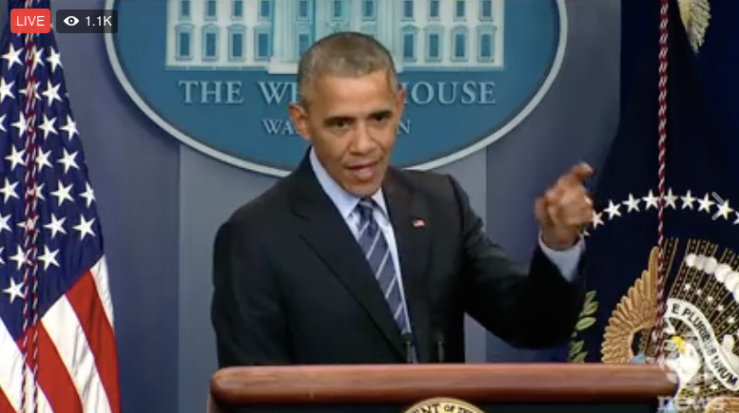
Today, Barack Obama met with the press for a year’s end news conference.  Being what may be his final conference, it was chock full of discussion on the relevant topics: Syria, Russia and especially doubt on the electoral system.  A moment near the middle interrupted the procession, with one of the offscreen attendees becoming sick and in need of a doctor.  Obama simply, casually, called for on site medical staff.  The camera panned slowly back, showing the heads of the room, all pointed to the right.  It was an oddly apt metaphor for the future, and for the casual simplicity of a government imposed medical coverage.

Obama met the crowd with a tired smile.  He looked exhausted – physically ready for a holiday, yet trepidatious about the future of his country.  He repeated again and again the need for a bipartisan view on government and politics, and recognizing the difference between American values and constructed, polarized views.  He mentioned the incredible reality that 37 percent of republican voters approve of Putin(based on one survey), saying that this reality would cause Reagan to would roll over in his grave. He claimed that this happened because everything that’s said lately is seen through a specific, polarizing lens: in Republican terms, how does whatever fact help us or hurt us relative to democrats or President Obama?

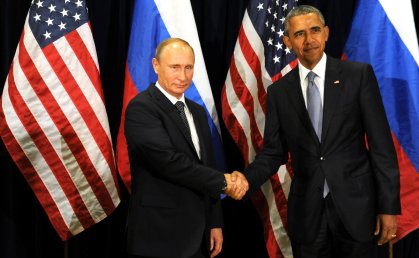
Vladimir_Putin_and_Barack_Obama_(2015-09-29)_01.jpgHe said it again and again: “Our vulnerability to Russia or any other foreign power is directly related to how divided… our political process is.  That’s the thing that makes us vulnerable.”

It’s an immediately sobering reflection on an already sobered country(appropriately, Trump himself avoids alcohol, choosing soda instead).  Discussing anything in political relations right now comes back to Russia, time and again.  When speaking of Aleppo and the United States’ inability to do anything without focussing more money and effort than congress is willing to approve, when speaking about the results of the election… everything came back to Russia.

Obama iterated again and again the necessity of a consistent journalistic narrative.  The facts are there.  Information is made available.  The issue is when that information is constantly reassessed to fit in with a newer political narrative.  Issues with Russian computer access to the DNC were public knowledge during the extent of the campaign, but this has been constantly reassessed as ammunition one way or another by each side of the conversation.  There’s only a certain extent to which we can realize reality as subjective.

It’s difficult to genuinely consider the investigation of tampering with the election to be a bipartisan issue, despite the fact that that’s inherently what it is.  While one has to recognize the Democratic party’s personal stake in the discussion, especially after losing the election, if the electoral system has been compromised then it has become something that affects any party and any result and needs to be assessed, even if that’s by the party that benefits from it.

Obama’s comments on Trump were general, attempting to reconcile the necessary ideal of a unified America.  How things have gone has been important, but the future of America is what needs to be considered.  It’s up to the people of America.  But Obama stressed the necessity in trusting in essential pieces of the American administration, especially in the Intelligence divisions.  “Unless the american people genuinely think that the professionals in the CIA, FBI… are less trustworthy than the Russians, then people should pay attention to what our intelligence agencies say.”

But Obama dissuaded claims that the issue is as complicated and grave as all that.  “The votes that were cast were counted appropriately; we have not seen evidence of machines being tampered with,” he said.

The Facebook comments that littered the side of the feed cast dispersions on the future, actively playing against the narrative that Obama presented.  Whether comments about how Trump would ruin America or about how ‘new evidence’ on Obama’s birth certificate clearly evidenced he was not a genuine American, the discussion, even when in vocal support, played against the prerogative the president was trying so hard to convey, continuously hammering in the hyper-partisan state of the union.

mele_kalikimaka_mug_by_goblinqueeen.jpg

“Mele Kalikimaka,” Obama said, exiting the stage.  A traditionalist sentiment expressed in less than traditional language.  A representation of different phonetic systems and realities that inhabit the different pieces of America.  Something that needs to be sustained.

Did Russia Hack the Election?

ih3hvika

Alright, alright alright.  Now, today’s blog is going to sound a little bit nutty.  I recognize that.  I own it.  This isn’t something that I necessarily believe in, but it’s definitely something that’s been on my mind.

All the Democrats are coming off as crazy.  They’ve been whining and complaining about how Donald Trump has been in Putin’s pocket ever since the beginning, and, though it seems silly, there is definitely some validity in that connection.  Putin has said positive things about Donald Trump in the past, likely because Trump’s limited, nationalistic view would allow him virtual free reign over the other side of the world.  By simply being ‘friendly’, he creates a brief, tenuous connection that aligns his global thinking to take advantage of Trump’s limited.

CGrqeIZUAAAwyKV.jpgSure, if anybody was going to hack the election for Trump, it would probably be Russia.  Or maybe it’d be corporate America; wouldn’t they have more control, anyway?  Heck, while we’re on it, maybe it was rigged by Hiram Lodge, the money-hungry owner of Lodge Enterprises from the pages of Archie Comics.  He seems like the kind of guy who would benefit from a blindly pragmatic capitalist at the top of the pecking order.

It’s silly, isn’t it?  Not even looking into how likely or possible it is, it seems strange just to assume that such a thing is possible.  But maybe, right?  Stranger things have happened in our world.

Unfortunately for the Left, they’ve been duped into setting an enormous precedent.

Back in October, which seems like a bright, sunny period from years and years ago, Donald Trump made the absolutely inane comment, when asked if he would accept the results of the election, that he’d “look at it at the time”.  This was followed with what seemed like an extremely desperate, pathetic series of rants about voter fraud, rigged voting, and even the fact that, because he considered Hillary to be a criminal, it was injustice that she was allowed to run.

Of course, the Left latched onto this.  It was ludicrous.  It was an insult to the democratic system.  It was pathetic and it was in poor taste.  It was childish, petulant whining due to the reality of an impending loss.  So they plastered it up everywhere they could, on newspaper and website headlines, damning the idiocy of such an idea.  How could someone question the sanctity of the system like this?

Well, maybe now we know.

TrumpSupremeCourt.jpgFollowing the totally insane results of the American election, the world has still been trying to put the pieces together.  How can an inexperienced Demagogue with no genuine convictions actually win an election like this?  How is he allowed to put such an insulting, horribly self-serving Cabinet together?  Did America seriously give Trump the keys to the country and expect him to bring it back unscratched?

But the recount seemed silly.   And now, this insane talk about Russia hacking the election seems like the most ludicrous assertion yet.

It seems like something Trump would say.

That’s what discredits it so much in the media.  That’s why people aren’t taking it nearly as seriously as they otherwise would.  Because they’ve condemned all the vapid, inane assertions of this kind that Trump made all through his campaign; after claiming that the election is such a holy, unbreakable entity, how disingenuous does it seem to suddenly flip around their practical ideology and begin slathering the news with what superficially appears to be the exact same brand of smut?

That’s the genius of it.

15439823_583152078557498_7379019250713588403_n.jpgWhat if Trump has known all of this from the beginning?  What if this was the basis of the last stretch of his campaign: making his inauguration seem legitimate?  By making these ridiculous assertions against the electoral system, it seemed that he was primed to lose.  And he was slaughtered in the press.  But now, having won the election, it seems that he was proven wrong.  And he’s set a precedent for doubting the electoral system being silly and crazy.

What if Trump made his ludicrous claims in expectation of a hacked election turning out in his favour?  What if he did this in order to temper the forthcoming news and to prompt eyeball rolls all across America in response to these insane claims of a broken electoral system?

After all, only the most desperate on the Left seem to be willing to believe it… throwing out third-party blame for losing the election seems too much like something Trump would have done.